
The Agentic Development Life Cycle
Build with agents.
Lead with intent.
Connect human judgment, agent execution, and real evidence. Turn an idea into work you can stand behind.
A framework for people building what comes next.
Human + agent. Same team.
A new kind of team.
A shared direction.
Agents can research, build, test, and act. ADLC gives that work a shared operating model: clear intent, visible evidence, and human accountability.
Humans set direction.
Choose the problem, define the boundaries, and decide what deserves to move forward.
Agents extend the work.
Explore options, create artifacts, and bring back evidence people can examine.

Six responsibilities.
One connected loop.
Work moves between intent, generation, validation, deployment, and observation. Governance holds them together.
Help a new team get started together.
Explore a simpler way to invite teammates during
onboarding.
Generate and Validate can run together. Observe can send you back to any part of the work.
Start with the change you want.
Make the outcome, assumptions, and boundaries clear before asking an agent to act.
- Human judgment
- Choose the user problem and decide what evidence would justify investing further.
- Agent work
- Explore available research and draft options, questions, and a build brief.
An intent brief
“Can a simpler invitation help new teams reach their first shared task?”
- Start with a clickable prototype.
- Use synthetic accounts and data.
- Do not send real invitations.
A hypothesis to explore, not an established result.
Make the idea tangible.
Turn the brief into something the team can inspect, question, and improve.
- Human judgment
- Choose the approach and resolve product tradeoffs the brief leaves open.
- Agent work
- Build alternative flows, prepare test data, and document the choices made.
A prototype to review
Two ways to invite a teammate
- Invite during setup, with a clear skip option.
- Invite after creating the first task.
- Include empty, error, and confirmation states.
Generation and validation can happen in parallel.
Ask what the evidence proves.
A working flow is one kind of evidence. Whether it solves the user's problem is another.
- Human judgment
- Assess the evidence, identify gaps, and decide whether the bet still makes sense.
- Agent work
- Run agreed checks, compare the flows, and surface failures and unresolved assumptions.
An evidence checklist
- Can the flow be completed using a keyboard?
- Are duplicate and invalid invitations handled?
- Do users understand what happens next?
- What have we still not tested?
Passing technical checks does not establish user value.
Make the next step deliberate.
Decide who can experience the change, what is allowed, and how to stop it.
- Human judgment
- Authorize the release scope, name an owner, and agree the stop conditions.
- Agent work
- Prepare the release, verify the configuration, and support rollback within its permissions.
A release decision
A limited pilot, with an owner
- Define the participating group.
- Confirm consent and invitation permissions.
- Check monitoring and rollback readiness.
- Record the decision and its rationale.
An illustrative release plan, not a live deployment.
Let reality change the plan.
Look for signals that support, challenge, or reshape the original intent.
- Human judgment
- Interpret what happened and decide whether to continue, change, or stop.
- Agent work
- Bring together permitted usage signals, errors, and feedback, with sources and limitations.
Questions for the next decision
- Where do people leave the invitation flow?
- Do invited teammates reach a shared task?
- What did users find confusing?
- Does the original problem still hold?
New evidence can redirect intent, the build, or the release.
Five principles.
A different way to work.
The habits that make the operating model useful, from a first experiment to a team working with agents.
Concurrency over sequencing
Generation and validation can happen together. Observation keeps informing intent. Organize around work that can safely proceed in parallel, with clear dependencies and boundaries.
Governance over execution
As agents take on more execution, human attention shifts toward direction, evidence, and accountability. The ability to make sound decisions becomes part of the team's delivery capacity.
Bets over requirements
Frame work as a hypothesis with a learning objective. State what you believe, what would change your mind, and how much you are prepared to invest to find out.
Loops over gates
Use evidence to revisit decisions throughout the work. Keep necessary approvals, and make them part of a continuous learning loop instead of the only moments when anyone looks closely.
Signal over assumption
Stay connected to users, systems, and the market. Ask where each signal came from and what it can support, so an untested assumption does not quietly become the foundation for more work.

The more agents can do,
the more judgment matters.
ADLC is an operating model for a world where agents execute and humans remain accountable. The work becomes a connected loop of intent, action, evidence, and decisions.
That changes how we build. It also changes where we put our attention: the problem worth solving, the boundaries that matter, and the evidence that earns the next step.
For product people, engineering leaders, founders, and teams learning to build with agents.

The book behind the practice
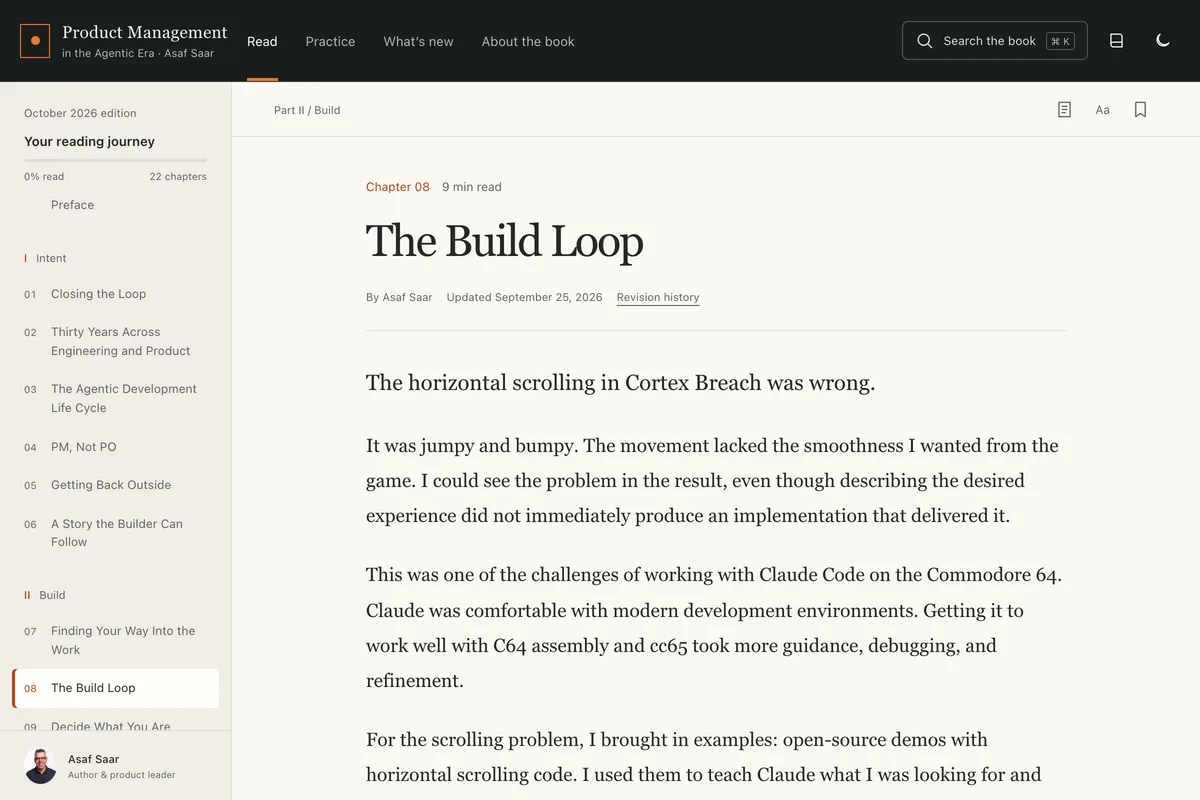
Product Management
in the Agentic Era
PM was always about what and why. Now we can start doing the how. Explore what changes when product people can build, gather evidence, and act with agents.
ADLC describes the development responsibilities inside a wider product outcome loop. The book follows that wider loop: Intent, Build, Evidence, Decision.
$19.99 USD · One-time purchase
Read online on any device. Every future edition included.
Intent
Find the problem and give a builder clear direction.
Build
Move from a first attempt to working with agents.
Evidence
Examine what the work establishes and what it does not.
Decision
Make the investment, authority, and leadership calls.
Read it. Work through it.
Come back to it.
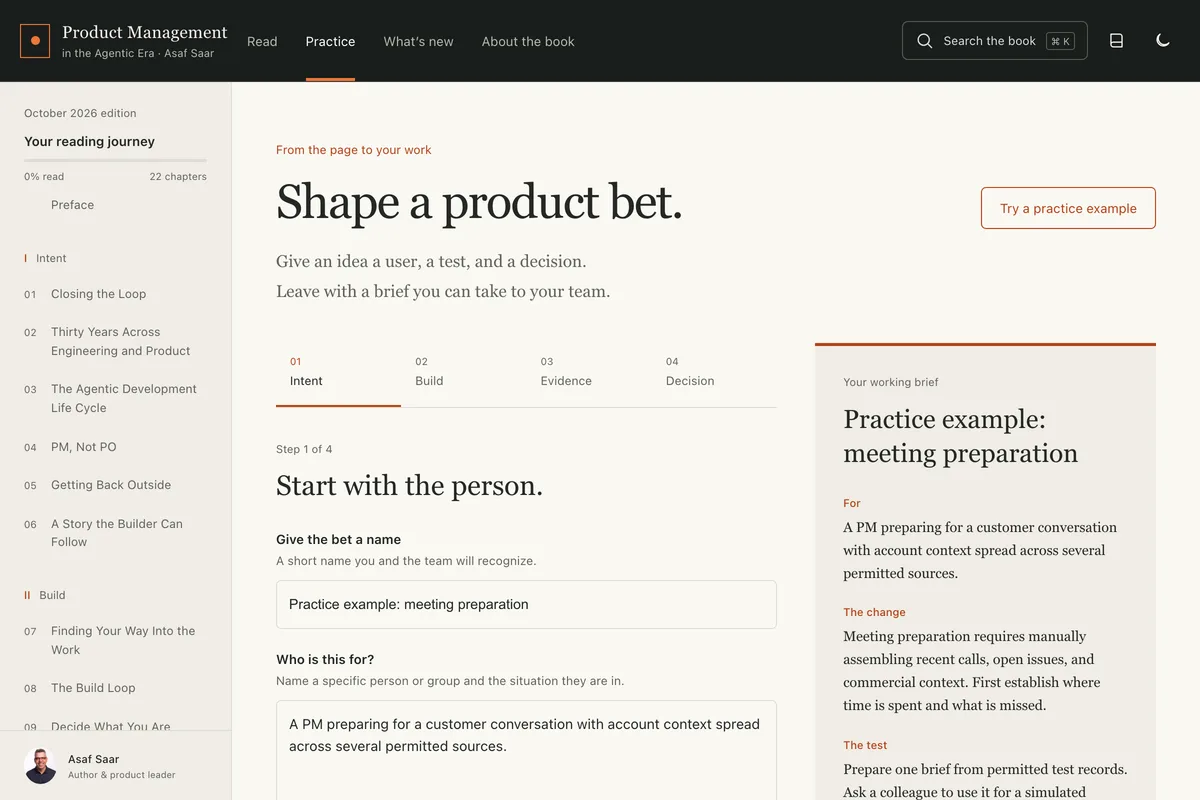
Search the text. Keep a private notebook. Shape a product bet in the practice workspace. Revisit the ideas as new dated editions arrive.
Bring your judgment.
Build what comes next.
Start with the framework. Go deeper with the book.